


Ask an analyst what they spend their time on and the answer splits in two.
There is the work that arrives on a calendar. Results, monthly and quarterly updates, coverage monitoring, keeping models current. It repeats, it has a deadline attached, and it has to be done properly whether or not anything interesting happened. It is maintenance.
Then there is the work that arrives without warning. A client asks a question about a name you have not looked at in a while. Maybe it is a read across from a stock move on a competitor's print but not in your direct coverage list. A Samaya workflow can look at the read across impact to your coverage, the client’s question and any sector implications.
Different rhythms, same underlying problem. Before an analyst can apply any judgement, someone has to gather the information, read it, reconcile it and work out what matters. That part is time-expensive, it is the least differentiated thing an analyst does, and there’s never a good time to do it. Samaya does the gathering, mapping and analyzing.
What a workflow is
Getting good output from AI starts with knowing what to ask, which is a real barrier when the thing you are asking about is a results print at 7am.
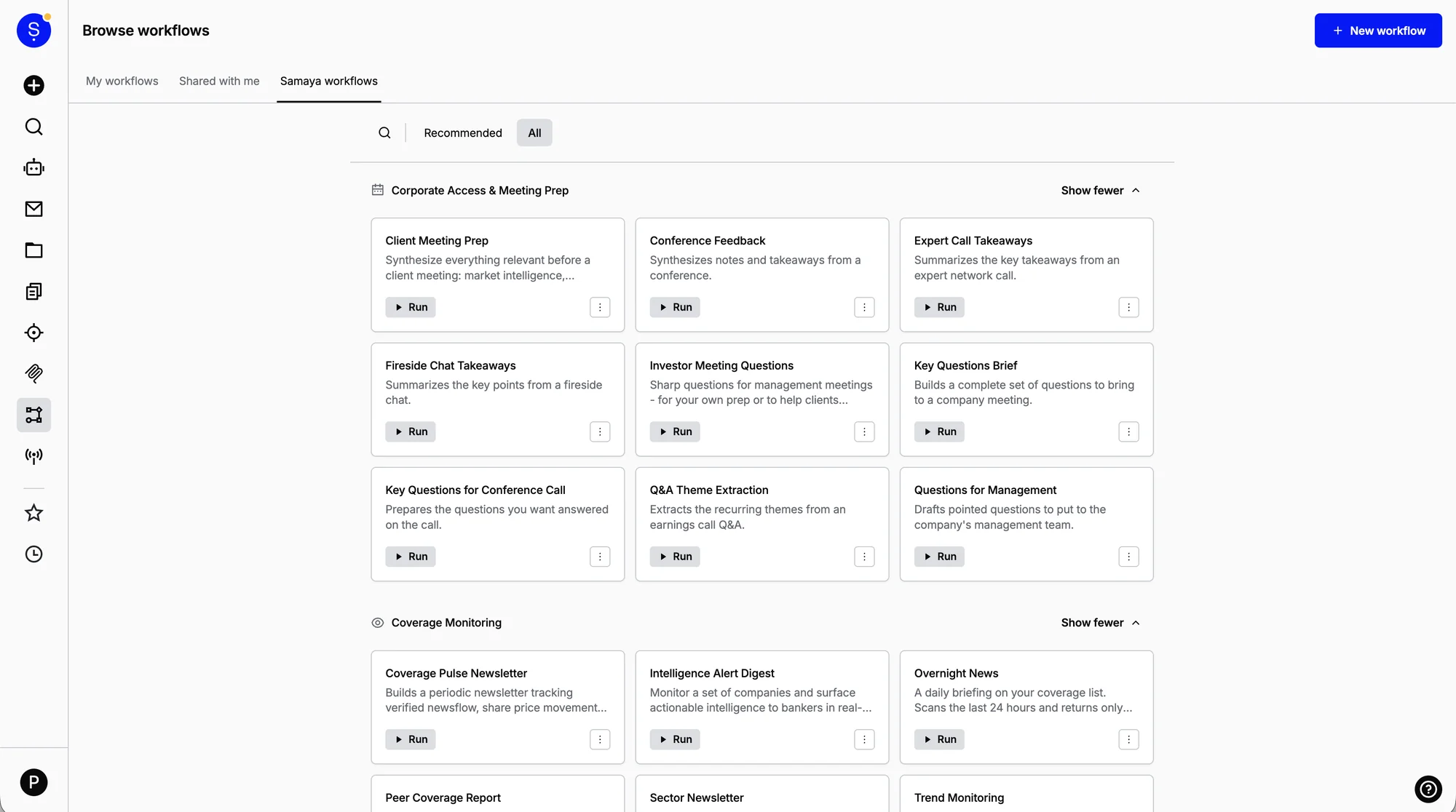
A Samaya workflow removes that step. Each one is built around a single job and already knows the questions that job requires. A results morning workflow asks different questions from an initiation, which asks different questions from a thesis test. Fifty of them are now live, covering buy-side and sell-side work.
After the call
On a heavy day you may have three calls in a morning and you cannot attend all of them. On the one you do attend, you are asking questions and actively taking notes. The call ends and everyone wants the same thing at once: the sales desk, your clients, and the market, want a note while the information is still worth something. Writing that note properly takes time you do not have. And writing that across three companies, two of which you were not on the call for - that is a Samaya workflow situation.
The post-earnings call workflow works from the call and the release together. It pulls the key themes, what changed against guidance, how management handled the questions the buy-side pressed, and the numbers management gave verbally on the call that never appeared in the release or the filing.
What they run on
These workflows point at what you already have. Your own published research, your firm's data, your own internal notes from company meetings, public company filings, transcripts, industry sources and releases. What comes back is a report or a framework ready to iterate on til you can publish, with every figure traceable to its source, because your name goes on the output and you have to be able to defend it.
What you do with the time
The point is not that the work disappears. It is that the part of the work that does not need you stops taking your day.
The time goes back to the things that cannot be delegated. Speaking to clients. Meeting management. Talking to industry experts and doing primary research potentially on the road. Working through a view with your team, or filling in the sales desk or the bankers on sector developments.
Fifty workflows are live now on the Workflows page. If there is one you want and cannot find, tell us and we will build it.