
Overview
Analysts rely on Samaya to run complex financial research. That research depends on accurate, sophisticated retrieval: pulling a specific number, such as one segment’s revenue in a given quarter or a company’s full-year capital expenditure, out of a vast sea of filings, earnings call transcripts and reports. At Samaya, we hold our system to the highest standard and evaluate it on the benchmarks best suited to that work. FinRetrieval [1] is one of the few built for this task: 500 questions, each asking for a single value stated in a single source document. On our first run, an earlier version of Samaya scored 80.2%, and the first misses we reviewed traced back to the benchmark’s annotations rather than to the system.
Could a cleaner version of the benchmark tell us how close we are to solving the task?
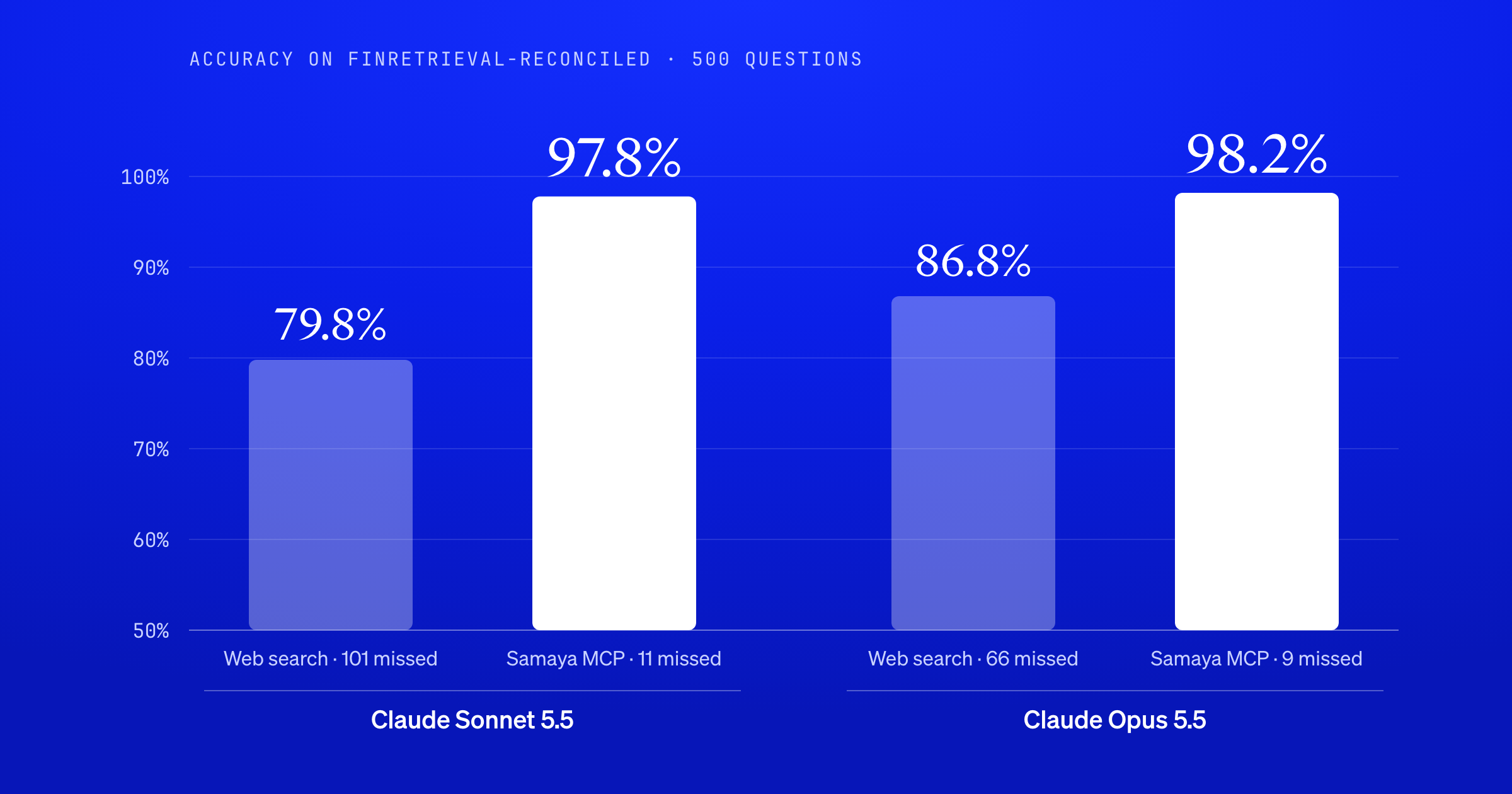
We audit all 500 questions, re-annotate the faulty ones and release the result as FinRetrieval-Reconciled. On it, Claude Opus 5.5 connected to Samaya’s MCP scores 98.2%, against 86.8% for the same model with Anthropic’s official web search.
The key takeaways:
- We find annotation problems in 114 of 500 questions (22.8%). They fall into five types: answer values, computed values, units and currency, question meaning and scope, and reporting periods (Figure 1).
- We correct each one against the source filing. Every question is held to FinRetrieval’s own definition of a valid question, and every change is reviewed by experts and published with its reason (Figures 2 and 3).
- We find that Samaya nearly solves the corrected benchmark. With Samaya MCP as their only search tool, Claude Opus 5.5 and Claude Sonnet 5.5 score 98.2% and 97.8%, against 86.8% and 79.8% for the same models with web search (Figure 4).
- We release FinRetrieval-Reconciled on Hugging Face with the original and corrected version of every changed question.
Evaluating Samaya with FinRetrieval
FinRetrieval, introduced by Kim and Huang (2026) [1, 2], tests whether an agent can find “specific numeric values…given natural language questions” (values of financial significance, such as revenue or cash flow). Each question names a company, a metric, a period and a unit, and the answer is stated directly in one source document (such as an annual report, a quarterly filing or an earnings call transcript). The set covers US and non-US companies, and some source documents are not in English. Each question comes with an oracle answer key grounded in a particular document, and at evaluation time a system’s answer is graded against that key by an LLM judge.
Because each question should have exactly one correct answer, the benchmark is only as reliable as its answer keys. A wrong key marks a correct answer as a miss; enough wrong keys cap the attainable score below 100% and make gaps between systems hard to read.
Our initial evaluation of Samaya on FinRetrieval yields a score of 80.2%. However, a close audit of Samaya’s predictions points not to system failures but to severe annotation issues in the dataset. For example, one question asks for Man Group’s 2018 net cash from investing activities in British pounds; Man Group reports in US dollars, and the answer key records the $97.0 million figure as £97.0 million.
To understand the true performance of Samaya, we therefore audit and correct the entire dataset, uncovering a total of 114 annotation issues with the following distribution (Figure 1; Appendix A defines each type with an example):
Errors of this kind are expected in a dataset of this size built from filings in several languages. The authors release their data [2], code and tool traces, which is what makes a full audit possible. Their paper also identifies fiscal-year naming as the main reason models score 5.6 pp lower on non-US companies [1], consistent with much of what we find.
FinRetrieval-Reconciled: an audited and corrected benchmark
We hold every question to FinRetrieval’s own standard: one value, stated directly in one document, with no calculation needed. Questions that meet it are left unchanged. Questions that do not are rewritten, given a corrected answer, or both. Where a question has more than one defensible answer (for example, an originally reported and a later restated figure), we keep the original and add the other as an accepted alternative.
The audit runs in three stages:
- Stage 1: Samaya pass. We ask every question in the Samaya app and check each answer by hand against its source document.
- Stage 2: Independent second-system pass. We ask every question in a different AI system augmented with search capability and check those answers the same way. Using a second system guards against any bias introduced by Samaya’s own search.
- Stage 3: Manual review. Each question is reviewed against the full set of relevant documents returned in the first two stages, and each proposed change goes through several rounds of review before it is accepted.
Since Samaya helps check a benchmark it is scored on, we guard against shaping the test toward our own system with three safeguards.
- Human verification. A person checks every correction against the source filing; no change is accepted because a model suggested it.
- Benchmark-defined criteria. Whether a question changes depends on FinRetrieval’s definition of a valid question, not on whether Samaya answered it correctly.
- Full disclosure. Every change is public. Figure 2 lists all 114 with the original question and answer, the corrected version and the reason.
In total, our audit results in a change to 114 of the 500 questions (22.8%). Figure 2 shows every question in the benchmark; select a colored circle to see what changed and why. Figure 3 breaks the changes down by what was edited: a third required fixing both the question and the answer.
Results
After this audit, we believe FinRetrieval-Reconciled is a much more reliable benchmark than the original for evaluating a system’s ability to retrieve financial data. With it, we compared Samaya’s MCP against web search as the search tool for two models, Claude Opus 5.5 and Claude Sonnet 5.5. For the baselines, each model uses Anthropic’s official Claude web search API. For the Samaya runs, we connect the same model directly to Samaya’s MCP in place of any other search tool. The model is identical within each pair and only the search tool changes, so each comparison is apples to apples.
With Samaya MCP, Claude Opus 5.5 answers 491 of the 500 questions correctly (98.2%), against 434 (86.8%) with web search. Claude Sonnet 5.5 answers 489 correctly (97.8%) with Samaya MCP, against 399 (79.8%) with web search. Replacing web search with Samaya MCP cuts Opus 5.5’s misses from 66 to 9 and Sonnet 5.5’s from 101 to 11 (Figure 4).
Wrapping up
Reliable financial research leaves almost no margin for error: a single misread unit, wrong fiscal period or missed restatement can undermine an entire analysis. Once benchmark noise is stripped out of FinRetrieval, the practical gap between systems becomes stark. Connected to Samaya’s MCP, Claude Opus 5.5 misses only 9 of 500 questions (98.2%) and Claude Sonnet 5.5 misses 11 (97.8%), compared with 66 and 101 for the same models with web search: the difference between an agent analysts can trust on primary filings and one whose numbers still have to be checked by hand.
We are making the audited FinRetrieval-Reconciled dataset available for community use, to facilitate future research in this direction. It includes the original and corrected version of all 114 changed questions and the reason for each change: huggingface.co/datasets/samaya-ai/FinRetrieval-Reconciled.
References
[1] Kim, E. Y., & Huang, J. (2026). FinRetrieval: A benchmark for financial data retrieval by AI agents. arXiv preprint arXiv:2603.04403. https://arxiv.org/abs/2603.04403
[2] Daloopa. (n.d.). FinRetrieval [Data set]. Hugging Face. https://huggingface.co/datasets/daloopa/finretrieval
Appendix A. Categorization of annotation issues in the original FinRetrieval dataset
We show below the five categories of annotation issues we found in the original FinRetrieval dataset, which together account for all 114 corrected questions. Each corrected question is counted once, under its main issue. The categories are listed from most to least common, each with a short definition and one representative example; each example gives its question id, which you can find in Figure 2.
Answer value issues (29 · 25.4%)
The question was sound, but the expected answer couldn’t be defended: rounded differently from the filing, misread from a table, taken from the wrong line item or replaced by a later restatement. Where two answers were valid, we accepted both.
Question required a computed value (27 · 23.7%)
The expected answer wasn’t printed in any filing. Most were single-quarter cash-flow figures that companies only report year-to-date, so the answer key had subtracted one period from another. We rewrote these to ask for the period the filing actually prints.
Units and currency issues (23 · 20.2%)
The number was right, but its units weren’t: the wrong currency, the wrong scale (thousands versus millions), a percentage mixed up with basis points, or no unit at all.
Question meaning and scope issues (22 · 19.3%)
The question didn’t identify a single fact. Some lost their meaning in translation. Others could be read two ways, or didn’t say whether they meant the whole company or a segment, reported or adjusted.
Reporting period issues (13 · 11.4%)
The question and answer referred to different periods: fiscal and calendar years mixed up, the wrong quarter, a single quarter confused with year-to-date, or the wrong as-of date.