



The ability to conduct rigorous, end-to-end financial research that drives investment decisions remains a major open problem for AI. On Samaya’s FrontierFinance benchmark [1, 2], which evaluates AI’s ability in workflows across the investment process, even the best performing frontier model (Claude Fable 5.1) achieves only 55.9% accuracy, with huge gaps in use cases like screening and macro research.
Could post-training a model close this gap?
Surprisingly, we find that post-training even a much smaller model results in a meaningful increase in quality over Fable 5.1 and an 11× decrease in cost. In this post:
- We post-train a 30B mixture-of-experts (3B active parameters) Nemotron 3.5 Lightning model from 42.5% to 58.9% accuracy on FrontierFinance at $0.61 cost (compared to Fable 5.1 at 55.9% accuracy and $6.89 cost.) See Figure 1.
- We do this via a four stage training process, starting with two supervised learning training stages where the model learns to do research with financial tools, choose research strategies, and aggregate citable responses, learning from eight diverse teachers. This is followed by two RL stages, where the model first learns to further advance research capabilities through offline RL and then learn from its mistakes in online RL.
- We find substantial gains from the model and harness being co-adapted through the post-training process. The harness provides high-quality financial tools that the model learns to use effectively through training, and compresses long traces and tool results so that even a small model can sustain long research. Explicit guidance to plan and research hard questions in depth further improves performance, as it does across frontier models [3, 4].
- We see even bigger gains with larger models. Early results with a larger model trained on the same recipe show more gains, which we will share in a future post.
Environment setup
Our environment combines Samaya’s finance harness with research tasks of the kind an analyst carries out. Building a harness that supports decision-grade financial research with a small model took careful design.
Samaya’s production harness has dozens of finance-specific tools, including data-source tools powered by our in-house retrieval models. We adapted it for a small model: We stripped detailed guidance from the system prompt and tool descriptions, since the model can learn these nuances in training, and merged tools to shorten the prompt. We developed two helper models to manage context: A condenser shortens long tool results, and a compactor summarizes the trace as it grows. A research budget caps how long the agent researches, after which the report writer answers from what was found. Together, these let a model with 3B active parameters sustain research across many tool calls.
The research tasks are questions such as “What are the interest coverage ratios for AT&T and Verizon for each quarter from 2019–2023? How have their debt service capabilities changed?” Answering one takes many tool calls over several turns and gathering evidence for a final report with granular citations. We train our model as a research agent, gathering evidence and planning its next research steps as it executes. A separate report writer turns this into the final output (Figure 2).
Training questions come from an internal dataset that finance professionals wrote and graded with the same process as FrontierFinance. FrontierFinance itself is strictly held out, with no benchmark question used for training and every checkpoint chosen on a separate pool of 100 internal validation questions. In fact, the expert-graded questions used for SFT and offline GRPO are easier than FrontierFinance. We add some harder questions in synthetic SFT and online GRPO (see Additional results). We find that the post-trained model sees quality gains at every difficulty level of FrontierFinance (Figure 7, in Results).
Training process
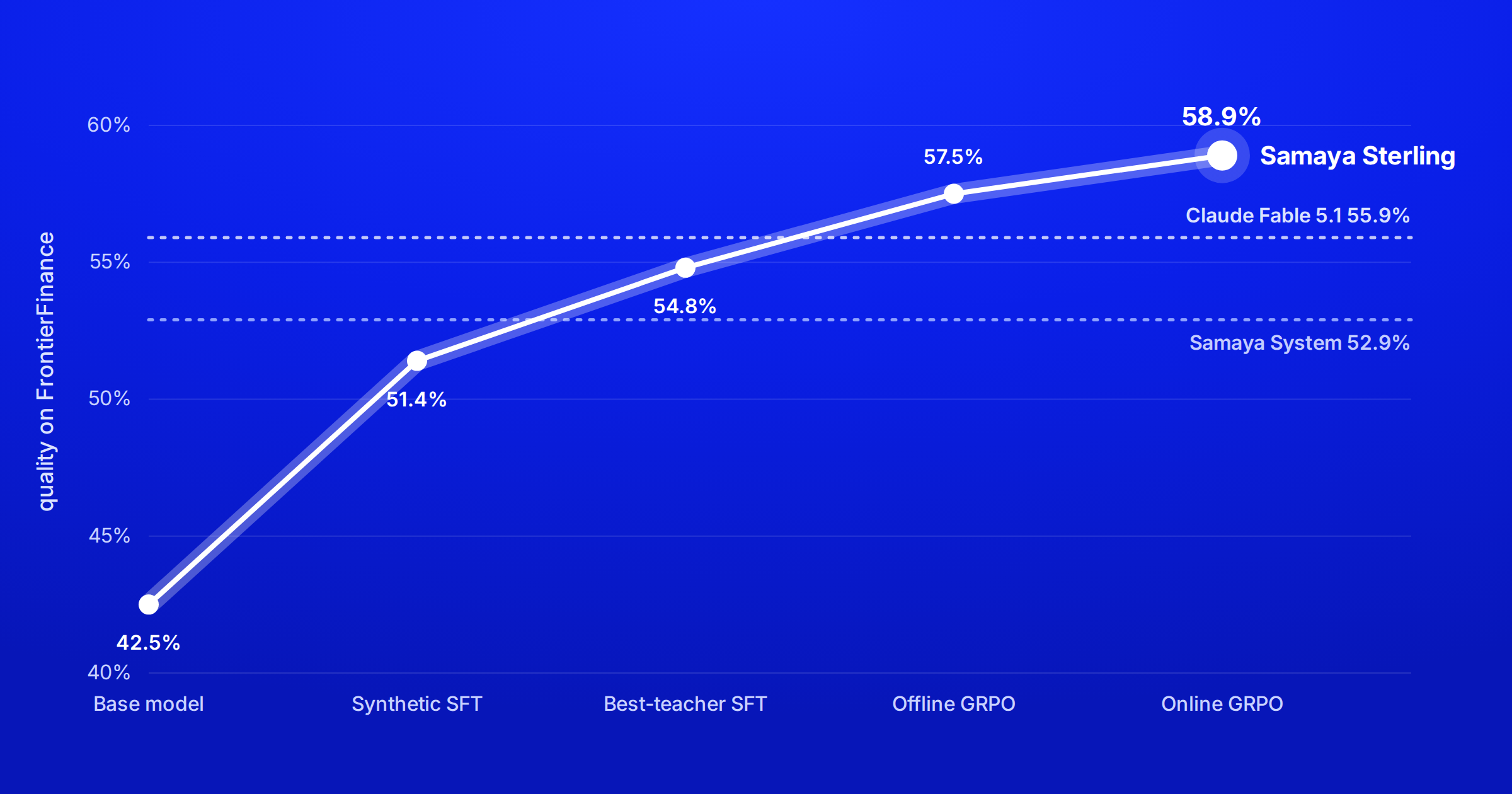
We start with NVIDIA’s Nemotron 3.5 Lightning, an open-source 30B mixture-of-experts model with 3B parameters active at a time, with reasoning (“thinking”) enabled. We train it with LoRA [5] on Tinker, Thinking Machines Lab’s training API, over four stages, two of supervised fine-tuning (SFT) and two of reinforcement learning (RL), which take it from 42.5% to 58.9% on FrontierFinance (Figure 3).
Stage 1: SFT on synthetic research traces. Supervised fine-tuning (SFT) trains the model to reproduce example traces token by token. We generated 968 synthetic analyst questions whose mix of use cases, skills and difficulty matches our training dataset. Unlike the expert-graded questions used in later stages, these have no rubrics: The teacher, Kimi K3, answered each question twice with our tools, and an LLM judge picked the better answer. This stage teaches the base model to call our 37 tools with valid arguments, gather evidence and finish by calling the report writer once its research is complete.
Stage 2: SFT on the best of eight strategies. In this stage, we want the model to pick the right research strategy for each question. Research strategies vary substantially according to the question, e.g. a question about one company’s quarterly results may be best served by pulling figures straight from filing tables, while a question about recent market events may call for leading with web search. We teach this by continuing SFT on the best of eight strategies. We prompt the teacher, Kimi K3, with eight research strategies (Figure 4; our advisor model training work [4] shows more examples). Each of the eight strategies answers the same 1,819 expert-written questions, and each answer is graded against the question’s rubric. The best-graded answer per question becomes the training example. Choosing the best answer per question makes a substantial difference in quality: The best of the eight answers, each from a different strategy, satisfies 80% of essential rubric items on average, against about 66% for the single best strategy. We drop answers in the bottom quarter by length or by number of tool calls and train for five epochs on the remaining 1,157 questions; epoch 3 scores best on validation, and later epochs overfit.
Stage 3: Offline GRPO on all eight answers. For the third stage, we use RL so the model sees how different research strategies (both strong and weak) score against the real task, and learns new behaviors [6]. We do this using the eight teacher traces, each with a different research strategy, and use GRPO (group relative policy optimization) [7], which scores each answer against the others for the same question: Its advantage is its reward minus the group’s average reward, so answers above the average become more likely and answers below it less likely. Because the answers already exist as teacher traces, as in DPO [8], the model learns from the contrast without generating anything, which makes each step cheap. One pass over the questions takes 132 steps of 8 questions × 8 answers, and the reward is the share of the question’s essential rubric items satisfied.
Stage 4: Online GRPO on the model’s own attempts. In the last stage, the model learns from its own attempts, so it sees its own mistakes and gets a reward for each of them. It answers each training question eight times, a grader scores each answer against all of the question’s rubric items, and GRPO updates the model on those scored attempts. We trained the model for 26 steps of 16 questions × 8 attempts, on questions where the teachers’ scores varied and, in the last four steps, questions where the agent most often ran out of research budget. To correct for the small mismatch between the sampling and training models, a known issue for mixture-of-experts models [9], we use truncated importance sampling, and we tune hyperparameters offline on stored attempts for cost-efficient exploration.
We hold out 100 internal questions as a validation set and run the full agent on them after each epoch or every few dozen steps to choose checkpoints. Figure 5 shows the validation score through the four stages.
Results
We find that Samaya Sterling satisfies 58.9% of rubric items on the 220 public questions of FrontierFinance [1], 3.0 pp above Claude Fable 5.1 and 2.9 pp above the Samaya System’s high-effort configuration. A question costs $0.61, against $6.89 for Fable 5.1 and $1.81 for high effort, at a similar latency (282 s against 268 s and 278 s; see Appendix A for the full leaderboard by cost and latency).
Samaya Sterling can also run in a high-effort mode that researches each question in more depth; in that mode it reaches 60.6% (see Additional results). Training lifts the base model from 42.5% to 58.9% and increases the depth of its research, with its median number of tool calls per question rising from 3 to 17. The Appendix B follows one question through each training stage. The gains are not limited to easy questions: Samaya Sterling improves on every difficulty third of the benchmark (Figure 7).
With our trained model, the research costs $0.04 per question; for comparison, frontier closed models doing the same research in the same harness cost $0.56–0.95. The rest of the $0.61 goes to tool calls and the helper models.
Additional results and what we learned
Every stage adds quality. On FrontierFinance, the base model scores 42.5%, synthetic SFT 51.4%, best-teacher SFT 54.8%, offline GRPO 57.5% and online GRPO 58.9% (Figure 8). The two imitation stages add 12.3 pp; the two RL stages add 4.1 more on top of a strong SFT checkpoint. Appendix B follows one question through every stage to show what changes in the research itself.
Hard questions improve most in the stages that train on them. On the hardest third of FrontierFinance, the base model scores 31.8%. Synthetic SFT, where 384 of 968 questions are hard, raises this to 40.3%. Best-teacher SFT, whose expert-graded questions are only 4% hard, lifts the easiest third from 61.3% to 67.7% but leaves the hardest third at 39.0%. Offline GRPO brings it to 41.9%. Online GRPO, whose pool is 30% hard after sampling, raises it to 45.2%, more than twice its overall gain. Over the full recipe, the hardest third gains 13.4 pp (Figure 7).
Gains on our validation set carry over to the benchmark. We choose every checkpoint on 100 internal validation questions and never on FrontierFinance, and the two scores rise together through the stages (Figures 5 and 8). The validation set also tells us when to stop training: Best-teacher SFT scores highest after epoch 3 and lower after later epochs, so we keep the epoch-3 checkpoint.
Small harness changes move scores, so we train in the harness we serve. Small harness changes, such as what the report writer sees, move scores in either direction, so we train and evaluate in the harness we serve. Trimming the tool list and compressing long results let a 3B-active model sustain research that would otherwise overflow its context.
High-effort mode buys more quality. The same Samaya Sterling checkpoint, configured in high-effort mode, researches each question in more depth. It satisfies 60.6% of rubric items at $1.83 per question and 372 s (mean of two runs). That is about the cost of the Samaya System’s own high-effort configuration ($1.81), with 4.6 pp more quality.
A progressive curriculum for online RL raises quality further, at a higher cost. For online RL, the final recipe chooses training questions by filtering on variance, then samples them at random. We also tried a progressive curriculum that samples on variance in addition to filtering on it. Each question is ranked by how much its reward varies across attempts, and its chance of being drawn shifts during training from low-variance questions toward high-variance ones: At the start the lowest-variance questions are seven times as likely to be drawn as the highest, halfway through all are equally likely, and by the end the preference is reversed. This variant searched more and reached 59.6% at $0.76 per question, against 58.9% at $0.61 for the final recipe.
The reward can set the trade-off between quality and cost. We experimented with penalizing versus rewarding a longer research context in online GRPO. Our results show that the reward alone can move the operating point: At step 20, the context-length penalty lowered cost by 30% for 1.1 pp less quality, and the context-length bonus raised quality by 0.9 pp for 115% more cost (see Appendix C for details).
Conclusion
We post-trained a 30B model with 3B active parameters in four stages, together with the harness it runs in. On FrontierFinance it scores 3.0 pp above Claude Fable 5.1, the strongest frontier model on the leaderboard, at 11× lower cost per question ($0.61 against $6.89). We plan to build on this in three ways:
- Multi-agent research. We are exploring using a large swarm of smaller, cheaper agents that are able to cover many diverse research strategies. These different strategies were central in making our teacher traces useful in uncovering more signal.
- Firm-specific models. This training process can also be used to build firm-specific models that encode firm-specific expert judgement via data, tools, and historical decisions in model parameters.
- Post-training larger models. We are training a larger model using a similar training process, with early results showing even greater gains.
Get in touch if you’d like to learn more about these directions.
Appendix A. FrontierFinance leaderboard by cost and latency
Figure 9 places Samaya Sterling among the systems on the public FrontierFinance leaderboard, by quality against cost per question and against latency. On quality against cost, Samaya Sterling Pareto-dominates every high-quality system on the leaderboard.
Appendix B. Analysis of checkpoints on a single question
Figure 10 follows one FrontierFinance question through the training checkpoints: “What are the interest coverage ratios for AT&T and Verizon for each quarter from 2019–2023? How have their debt service capabilities changed?” Answering it takes operating income and interest expense for 40 company-quarters (2 companies × 20 quarters), one consistent formula, and a note on the quarters where the ratio is misleading.
- Base model. Makes 5 tool calls, misses the metrics the ratio needs, and satisfies 30.8% of the rubric items.
- SFT checkpoints. Search more systematically, but wrong metrics and invalid tool arguments still hold them back. Best-teacher SFT reaches 64.6% with 23 tool calls.
- Offline GRPO. Gathers more evidence (48 tool calls) but scores 60%, below best-teacher SFT on this question.
- Online GRPO. Requests operating income and interest expense by name, fills in missing quarters and checks the unusual ones, without web search. It satisfies 92% of the rubric items with 30 tool calls, at about half the cost of offline GRPO ($0.74 against $1.54) and 70% of its latency (373 s against 521 s).
The final model gathers the inputs the calculation needs, checks where the calculation can mislead, and calls the report writer when it has enough evidence.
Appendix C. Reward shaping: Quality against cost
The rubric reward measures quality only. Because GRPO compares attempts at the same question, an extra term in the reward shifts which attempts count as better. We added a term as a function of the length of the agent’s research context, zero up to 80,000 tokens and growing to 0.3 at 240,000 tokens, once as a context-length penalty and once as a context-length bonus, in two online runs that are otherwise identical to a third run without it. Figure 11 shows their intermediate checkpoints after 10 and 20 steps. At step 20, against the run without the term, the context-length penalty lowered quality by 1.1 pp and cost by 30%, with 19% fewer tool calls. The context-length bonus raised quality by 0.9 pp and cost by 115%, with twice the tool calls. This gives a training-time control over the quality–cost trade-off, in place of hand-written limits in the agent’s guidelines.
References
- FrontierFinance benchmark website. research.samaya.ai/benchmarks/frontier-finance
- Yuhao Zhang, O. Ozan Koyluoglu, Thejas Venkatesh, Richard Diehl Martinez, Vishank Bhatia, Arash Alidoust and Ashwin Paranjape. FrontierFinance: A Challenging Benchmark for Measuring Frontier Intelligence of Finance Agents. arXiv:2608.11683, 2026.
- Samaya. Frontier AI models outperform human experts on earnings prediction for the first time. Samaya AI blog, 2026. samaya.ai/blog/frontier-ai-models-outperform-human-experts-on-earnings-prediction
- O. Ozan Koyluoglu. Hindsight Structured Advice Distillation: Teaching a Small Model to Guide a Research Agent. arXiv:2610.13000, 2026. Samaya AI blog: samaya.ai/blog/hindsight-structured-advice-distillation
- Edward J. Hu et al. LoRA: Low-Rank Adaptation of Large Language Models. International Conference on Learning Representations (ICLR), arXiv:2106.09685, 2022.
- Sarthak Mittal, Leo Gagnon and Guillaume Lajoie. Beyond Distribution Sharpening: The Importance of Task Rewards. arXiv:2604.16259, 2026.
- Zhihong Shao et al. DeepSeekMath: Pushing the Limits of Mathematical Reasoning in Open Language Models (GRPO). arXiv:2402.03300, 2024.
- Rafael Rafailov et al. Direct Preference Optimization: Your Language Model is Secretly a Reward Model. arXiv:2305.18290, 2023.
- Ling Team. Every Step Evolves: Scaling Reinforcement Learning for Trillion-Scale Thinking Model. arXiv:2510.18855, 2025.